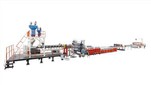
As we all know, the intermeshing co-rotating twin screws are modular. If the various types and numbers of screw elements are small building blocks that make up the screw, then the local screw configurations of various functional segments are large building blocks that make up the screw.
Therefore, to solve the combined design of the entire screw, in addition to having a clear understanding of the performance and structure of various screw elements, it is also necessary to have an in-depth understanding and grasp of each functional segment and its corresponding local configuration.
Next, let's take a look at the combined design of different functional segments of the extruder screw.
The intermeshing co-rotating twin-screw extrusion process generally consists of functional sections such as feeding, solid conveying, melting, melt conveying, mixing, and exhaust. Different functional sections require different local screw configurations to adapt to them in order to complete different functions.
Screw configuration of the feeding section
The feeding section mentioned here refers to the screw section facing the lower part of the first main feeding port, as well as the screw section facing the downstream feeding port. The main requirement for the feeding section is to be able to smoothly and adaptably add various materials, including granular materials of various shapes, low bulk density powders, fibrous additives, etc. This section generally uses large lead and positive screw conveying elements.
When the depth of the screw groove remains unchanged, the large lead means a large screw groove volume. For the feeding section facing the first feeding port, it can accommodate and add large volumes of materials. For the feeding section facing the downstream feeding port, it can create a low filling degree of the material transported from the upstream to accommodate the newly added materials.
Most twin-screw extruders use large lead standard screw elements with the same depth as their section screw elements. Some twin screws also use non-standard screw elements with increased screw groove depth to obtain large feeding capacity and conveying capacity.
Screw configuration for solid conveying section
The function of the solid conveying section is to convey the added solid material along the screw toward the die, and at the same time, to compact the loose powdery low-density material or increase the filling degree of the granular material in the screw groove during this conveying process, so as to promote the melting and plasticization of the material downstream.
The screw configuration of this section is: the screw element connected to the screw element of the feeding section should adopt a large-lead positive screw element, and then a positive screw element that reduces the screw groove volume should be adopted, mainly using a screw section composed of screw elements with segmented smaller lead. Figure 1 shows this situation. It can be seen from Figure 1 that the filling degree of the screw groove gradually increases along the conveying direction, and the material is compressed and compacted.

1:Screw configuration for solid conveying section
For low-density powdery materials, combining threaded elements of different leads to form a screw configuration that densifies the material generally does not cause any problems. However, if granular materials are being conveyed and the heating temperature of the corresponding barrel section is relatively low, excessive and rapid changes in the lead of the adjacent threaded elements may sometimes cause machine overload. Therefore, care should be taken when determining the degree of change in the lead of adjacent threaded elements.
Screw configuration in melt plasticizing section
The optimal local screw configuration for melt plasticizing a given polymer depends on the material's specific heat, melting point, melt viscosity and the size of the polymer particles in the solid state. The goal of the local screw configuration design for melting and plasticizing is to melt the material uniformly and quickly at a set temperature without inputting too much energy into the material.
There are two heat sources for melting the material, one is the external heat provided by the barrel heater, and the other is the shear heat introduced by the screw, the latter is the main one. In order to introduce shear heat, kneading blocks, reverse thread elements, and reverse mixer rotor-type non-standard thread elements (Figure 2) should be set in the melt plasticizing section, and these elements should be effectively combined with the upstream positive thread elements at a predetermined screw axial position, as shown in Figure 3.

RGS - right-handed
LGS - left-handed
S chauffl - left-handed and right-handed
2:Internal mixer rotor type large lead thread element

(a) Reverse screw element (b) Forward kneading block + reverse screw element
(c) Forward kneading block (d) Reverse asymmetric long lead screw element
3:Local screw configuration for melting
The standard for evaluating the quality of the local screw configuration used in the melting and plasticizing section should be that it can convert mechanical shear energy into thermal energy, so that the material melts the fastest and most thoroughly without increasing the material temperature, that is, the most reasonable energy utilization.
Experiments have found that in the configuration b in Figure 3, when the screw is running at high speed, the material melts very quickly and the length of the melting zone is very short. However, the temperature rise of the material in this section and its upstream area is very high, greatly exceeding the original set temperature and the energy required for material melting, and the melt pressure is also very high.
This shows that this screw configuration dissipates too much mechanical energy, and in addition to melting the material, it also greatly increases the melt temperature. Obviously, this is not the best.
When the ratio of added materials needs to be adjusted (the adjustment ratio is 1-5), it is obviously unreasonable to use the same screw. To reassemble the screw, the machine must be shut down, the head must be removed, and the downstream auxiliary machine must be removed. The recovery of the normal working cycle of the machine is long, which is not economically cost-effective (especially for large machines). At this time, the intermediate process regulating valve (radial, axial, rotary) can be used to adjust the flow and shear energy input to adapt to different ratios.
The better screw configuration for melting is the screw configuration d combined with asymmetric large lead thread elements as shown in Figure 3. It can make most materials undergo controllable constant shear and pressure, so the material temperature is not high.
In order to avoid excessive temperature gradients in the melting and plasticizing zone, the shear element and the forward thread conveying element can be combined alternately so that the total energy input is distributed in a certain order within a certain axial length, as shown in Figure 4 (c).

(a) Forward kneading block + reverse screw element (b) Reverse kneading block
(c) Forward kneading block and forward screw element are arranged alternately to the exhaust port
Figure 4 Berstorff screw configuration for melting
Local configuration of the screw in the exhaust zone
The intermeshing co-rotating twin-screw extruder is provided with an exhaust zone to remove moisture, entrained air and volatile components in the material. A sealing element should be set on the screw upstream of the exhaust port to seal the melt to establish high pressure; in the exhaust zone, that is, the screw section opposite to the exhaust port, the material should be filled at a low degree in the screw groove and connected to the atmosphere or vacuum pump.
To seal the melt and establish high pressure, reverse thread elements, reverse kneading blocks or pressure regulating valves can be used. In the exhaust zone, large-lead thread elements (Figure 5) should be used to form a low degree of filling and a thin melt layer, so that the material has a large free surface that can be exposed and a long residence time to facilitate exhaust.

Figure 5 Screw configuration in the exhaust zone
Screw configuration for melt conveying
Melt conveying generally uses forward-direction screw elements. However, sometimes kneading blocks or reverse-direction screw elements are used in the melt conveying zone of the screw, and pressure needs to be built up upstream of these elements for the material to pass through; in order for the material to pass through the die, pressure must also be built up in the melt conveying section at the end of the screw.
Pressure can only be built up in the screw section that is completely filled with material, so the pressure buildup of the meshing co-rotating twin screws comes from the ability of the material to continuously fill the screw groove. 100% filling allows the screw configuration with an axial channel to build up pressure in a short distance.
The length of the screw filled with the melt depends on the viscosity of the material, the screw lead, the number of screw revolutions, the feed amount and the die resistance. The thread lead and the number of thread heads affect the pressure buildup capacity.
Pressure buildup is accompanied by temperature rise, which is due to the low heat transfer coefficient of the polymer and the relatively low ratio of the screw cooling surface to the melt extrusion volume.
In order to minimize the temperature caused by pressure buildup, the pressure buildup screw configuration must be optimized to reduce the length of the back pressure zone and minimize the energy of the input material. The shortening of the back pressure zone means that at a predetermined pressure, the pressure gradient of the melt conveying section with a certain value of the convection rate must reach the maximum value.
It should be pointed out that if the screw configuration or operating conditions of the melt conveying section are improperly selected, it may lead to unstable extrusion, such as flow fluctuations; the full length of the melt conveying zone downstream of the exhaust port should not only extend to the exhaust pressure, otherwise it will cause exhaust material.
Screw configuration in the mixing section
The mixing function of the intermeshing co-rotating twin-screw extruder is the most important, so the screw configuration design in the mixing section is of great significance. Recently, it has been found that in the melting section of the twin screw, the size of the dispersed phase of the polymer blend decreases sharply, from the initial millimeter-level macroscopic particles or powder to tens of microns after the melting is completed.
After the initial blending stage, the larger particles of the dispersed phase of the blend are further reduced to the final micron level under the action of shear.
Compared with the effect of the melting section on the morphological structure of the blend, the effect of the melt conveying section on mixing is much smaller. In other words, the dispersed phase particle size changes greatly during the softening (for amorphous polymers) stage or the melting stage (for semi-crystalline polymers), while the dispersed phase particle size does not change much after the polymer is completely melted.

TM E - Turbine mixing element LH - Left-handed
KB - Kneading block SB - Single-start reverse screw element
Figure 6 W&P screw configuration with additional distributive mixing

Figure 7 Mixing section with increased mixing intensity consisting of two-head and three-head kneading blocks

Figure 8 Screw configuration consisting of kneading blocks and spiral elements for distributive mixing and dispersive mixing
Figure 6 shows the screw configuration of the twin-screw combination design, which is composed of toothed elements and other elements to increase the distribution mixing strength, while Figure 7 is a screw configuration composed of two-head and three-head kneading blocks suitable for increasing the melt mixing strength, and Figure 8 is a screw configuration composed of kneading blocks and screw elements for distribution mixing and dispersion mixing.
It should be noted that the selection of the screw configuration of each functional section must be combined with the task of the mixing operation to be carried out (blending modification or filling modification) and the mixing process.