


Pelletizing Line(Twin-screw compounding)
Jwell Machinery Co., Ltd., being in the No.1 position in China extruder making industry for the past 15 years, develops extruder granulators, which are key industrial equipment for realizing the "powder to granule" conversion and provide complete extrusion granulator the production process. It is a mechanical device that processes powdered, granular, slurry-like, or molten raw materials into granules (spherical, cylindrical, etc.) with specific shapes, sizes, and mechanical strengths through mechanical, physical, or chemical methods. Its core purpose is to improve the physical properties of materials through the granulation process, meeting the requirements of subsequent production or use.
JWELL industrial granulators include extruder granulators, extrusion granulators, industrial granulators, PET granulators, polymer system granulators, PET bottle granulators, PET bottle pelletizers, PET pelletizers, PP granulator machines, and more. If you have any requirements, please feel free to contact us. We will provide you with professional and detailed explanations and services.
-
 High Filler Pelletizing Line With High Capacity SeriesThis pellet extruder line is for high filler masterbatch production. Such as: PP calcium carbonate filler, PE calcium carbonate filler, talc filler, transparent filler, etc.Add to Inquiry
 -
 Eco-friendly Grafting & Chain Extension Pelletizing LinesTypical application: PE grafting for cable or pipe industry, MAH grafting for PE,PP,EVA,POE etc as compatibilizer, chain extension reaction for PET,PLA or PBAT to increase the viscosity.Add to Inquiry
 -
 Plastic Engineer Pelletizing LineEngineering Plastics pelletizing series are the main application of twin screw compounding filed , which can be used for polymer coloring, filling and blending, and also other mechanics, electrical,Add to Inquiry
 -
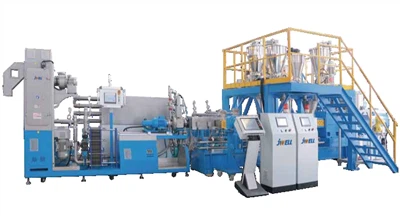 Thomoplastic Elastomers Pelletizing LinesThermoplatics pellet extruder(Thomoplastic Elastomers Pelletizing Lines) is mainly for the most potential new material at present, combining both advantages of plastic and rubber, which can be usedAdd to Inquiry
 -
 Lithium battery positive and negative slurry extrusion lineThe most active JWELL pellet extruder 2023,is Lithium Battery positive and negative slurry extrusion line. It is specially run based on rich experience on customers customization projects. TheAdd to Inquiry
 -
 Bio-degradbale Plastics Compounding And Pelletizing SeriesThe typical application of JWELL Bio-degradable Plastics Compounding and pelletizing seires are: plastic alloy, starch filled compound, bio-mass filled compound or mineral powder filled compound forAdd to Inquiry
 -
 PU/TPU Reaction Pelletizing Extrusion SeriesJWELL put a lot of efforts on the barrel processing accuracy and barrel cooling effect in PU/TPU Reaction Pelletizing Extrusion Series, based on the indepth understanding of the PU/TPU raw materialAdd to Inquiry
 -
 Silicone Adhesive Pelletizing SeriesSilicone Adhesive Pelletizing Series is one of the main advantageous products of JWELL machinery pellet extruder. Based on years of technical accumulation and continuous feedback from customers, theAdd to Inquiry
 -
 Color Masterbatch Pelletizing LinesJWELL color masterbatch pelletizing lines are applicable for black masterbatch, white masterbatch, color masterbatch and liquid masterbatch.Add to Inquiry
 -
 LFT-G Long-Fiber Reinforce Thermoplastic Compounding Mate...Comparing with traditional short fibre reinforming, LFT-G Pelletizing Line can reach even higher strength and specific strength, the thermal resistance is increased significantly. The resin generallyAdd to Inquiry
 -
 Pelletizing Twin Screw ExtrudersIn pellet extruder world, twin screw extruder is the name of pelletizing. In JWELL there are 4 choices of pelletizing twin screw extruders according to their key characters: 1. CJWA Basic Serie ofAdd to Inquiry
 -
 Tri-Screw Pelletizing ExtruderCo-rotating Parallel Tri-Screw Pelletizing Extruder,is the reinforced type of twin screw extruder, which suitable for material which is high requirement for mixing dispersion effect. It is mainlyAdd to Inquiry
- Tel: +8613816974389
- Email: salsz@jwell.cn
- Add: Shanghai Haining Suzhou Changzhou Zhoushan Chuzhou Thailand Spain
Extruder Granulator Product Features and Advantages
Granulation is not merely a simple change in form; it serves several important purposes:
Preventing dust and stratification:
It effectively reduces dust during production and use, improves the working environment, protects operators’ health, and minimizes material loss and explosion risks. It also prevents the segregation of materials with different compositions—caused by variations in density and particle size—during transportation, ensuring product uniformity.
Improving material flowability and enhancing automation:
Spherical or uniformly shaped granules have excellent flowability, which facilitates pipeline transport, automatic weighing, packaging, and feeding, laying a solid foundation for large-scale automated production.
Controlling dissolution rate and release performance:
Granulation allows control over particle density, porosity, and specific surface area. For example, in the pharmaceutical industry, it enables sustained or controlled drug release, while in the fertilizer industry, it allows the production of slow-release fertilizers, improving fertilizer utilization.
Facilitating subsequent processing:
It provides downstream equipment, such as tablet presses (for pharmaceuticals) and injection molding machines (for plastics), with ideal raw materials that have uniform specifications and good flowability.
Increasing bulk density, saving storage and transportation space:
Granular materials can be packed more tightly, significantly increasing bulk density, reducing packaging volume, and lowering warehousing and transportation costs.
Improving product appearance and enhancing commercial value:
Regular, uniform, and smooth granules are more visually appealing to consumers, enhancing both product quality and market competitiveness.
Extruder granulator Type
Industrial granulators are mainly classified into the following categories, based on the different working principles of granulation and the forms of materials.
Wet Granulation
This is the most common method. A typical wet granulation flow chart is as follows: a suitable amount of liquid binder (such as water, alcohol, or a polymer solution) is added to the mixed powder. Under mechanical actions such as stirring and shearing, the fine powders adhere and agglomerate to form a moist “soft mass,” which is then granulated using a specific shaping device. Typical equipment includes high-speed mixing granulators, fluidized bed granulators, and extrusion granulators (which use a die to extrude the wet material into strips that are subsequently cut). This method is widely used in the pharmaceutical, food, and chemical industries for materials that are not sensitive to heat.
Dry Granulation
A typical dry granulation process flow chart is as follows: without adding any liquid binder, strong mechanical pressure is applied to compress the powder directly into dense flakes or sheets using rollers. After subsequent crushing, granulation, and sieving, irregular but high-strength granules are obtained. This method is particularly suitable for materials that are sensitive to moisture or unstable when exposed to water or heat, such as certain pharmaceuticals and chemical products.
Melt Granulation
The material is first heated until it reaches a molten state, then atomized or dripped through a nozzle and solidified into spherical particles in a cooling medium (such as cold air or oil). This method is commonly used for plastic granulation (as the primary process), as well as for paraffin wax and for food or sugar granulation.
Spray Granulation
In this process, solutions, suspensions, or slurries are atomized into fine droplets, which are then dried and solidified in hot air to form spherical particles. This method is suitable for producing products such as milk powder, coffee, ceramic powders, dyes, and catalysts.
Components
An extruder granulator is a complex, integrated system. Its specific components vary depending on the type (such as wet, dry, or melt processes), but it typically includes the following core units, which work together to transform raw materials into finished products.
1. Power and Transmission System
This system serves as the “heart” and “muscles” of the granulator. It mainly consists of:
• Electric motor: Provides the primary power source for the granulation process.
• Gear reducer: Reduces the motor’s high rotational speed to the lower speed and higher torque required by the process.
• Drive shaft, bearings, and couplings: Reliably and stably transmit power to the actuators (such as the extrusion screw, rollers, or agitator).
This system ensures the entire machine has sufficient and stable power for material processing and forms the foundation for reliable equipment operation.
2. Raw material handling and conveying system
The supply and pre-processing of materials are crucial for ensuring continuous production and stable granule quality. This mainly includes:
• Feeding devices: Such as screw feeders, vibrating feeders, or belt scales, which continuously, uniformly, and precisely deliver powders or mixtures into the granulation unit. Accurate feeding control is essential for maintaining consistent granulation quality.
• Pre-mixing mechanism** (especially in wet granulation): Performs initial mixing before the material enters the main granulation zone to ensure a uniform material composition.
3. Core Granulation System
This is the “soul” of the granulator, where structural differences are most significant among granulators based on different operating principles.
• Wet/Extrusion Granulator:** Consists of a mixing paddle (which rapidly mixes the powder and binder into a wet, soft mass), an extrusion screw (which pushes and compresses the wet material), and a granulation die (with specific apertures and shapes through which the wet material is extruded into strips under high pressure).
• Dry Granulator: The core components are a pair of counter-rotating pressure rollers, typically featuring pits or textured surfaces. The powder is fed between the rollers and instantly compressed into dense flakes (compacts) under extremely high linear pressure.
• Fluidized Bed Granulator: The core section consists of a fluidization chamber and an air distribution plate at the bottom. The material remains in a boiling, fluidized state under the influence of high-pressure airflow. The binder solution is sprayed through atomizing nozzles, causing powder particles to adhere and grow.
4. Auxiliary Systems
These systems provide the necessary support and utilities for the core granulation process.
• Liquid Addition System (Wet Process): Includes liquid tanks, metering pumps, piping, and spray nozzles for precise and uniform binder application.
• Heating/Cooling System: Regulates machine temperature as required, using jackets, heating rods, or circulating media to control material plasticity and drying rate.
• Airflow System (Fluidized Bed, Spray Drying): Comprises fans, air filters, heaters, and ducts, supplying airflow with controllable temperature and velocity.
5. Post-Processing and Granulation System
The product from the core granulation system undergoes final shaping and refinement.
• Cutting Device: In an extrusion granulator, a rotating cutter located outside the die cuts the extruded strip into the desired particle length.
• Crushing and Granulation Mechanism (Dry Granulation): Large, compressed flakes are crushed by rollers or rotating hammers and then granulated using an Extruder granulator (such as a rotating screen) to produce relatively uniform particles.
• Drying Device: Some integrated granulators include a fluidized bed or oven to remove moisture from wet particles.
6. Control and Electrical Systems
Serving as the “brain” of the granulator, this system monitors and coordinates the entire production process.
• PLC (Programmable Logic Controller) and Human-Machine Interface (HMI/Touch Screen):** Used to set and adjust all process parameters, such as feed rate, screw speed, roller pressure, temperature, and liquid flow rate.
• Sensors and Instruments: Continuously monitor equipment operating conditions, including current, temperature, pressure, and speed. They provide feedback for automatic control and fault alarms, ensuring stable product quality and consistent repeatability.
parameter
1. Production Capacity Parameters
• Output: Usually expressed in “kg/hour” or “ton/hour,” output is a key indicator for evaluating equipment production efficiency and selecting appropriate machinery.
• Main Unit Power: Refers to the motor power driving the core components (such as screws and rollers), which determines the equipment’s strength and ability to process high-hardness materials.
2. Process Control Parameters
• Rotational Speed Parameters: Including spindle speed, screw speed, and cutter speed, these directly influence the material’s residence time, applied shear force, and the final particle size and density.
• Temperature Parameters: Critical for heat-sensitive materials or melt granulation, requiring precise control of barrel or fluidized bed temperature.
• Pressure Parameters: Especially in dry granulation, the “roll line pressure” is a key parameter, directly affecting the density and strength of the compact.
• Liquid Addition Ratio: In wet granulation, this refers to the ratio of binder to main material and must be measured precisely to ensure consistent granulation quality.
3. Finished Product Specifications
• Particle Size: Determined by the aperture of the granulation die or the mesh size of the granulator screen, particle size is the most direct specification of the product.
• Yield: The percentage of qualified particles relative to the total feed, reflecting both the performance of the equipment and the appropriateness of the process settings.
These parameters are interrelated and together form the core of granulation process control. Optimized combinations of these parameters ensure the production of ideal particles.
How it works (working principle) and granulation process
Core Working Principle The industrial granulator mainly operates based on the following three physical principles:
Agglomeration Method
Principle
Introducing a liquid binder (such as water, alcohol, or a polymer solution) forms “liquid bridges” between powder particles, causing fine powders to stick together and agglomerate into larger granules. These granules are then solidified and strengthened through rolling, stirring, or drying processes.
Equipment Applications
High-speed mixing granulators, fluidized bed granulators, rotary drum granulators, and similar equipment.
Visual Representation
Similar to slowly adding water to dry sand and stirring; the sand grains gradually stick together to form small clumps.
Extrusion Method
Principle
Strong mechanical pressure is applied to a wet, soft material pre-mixed with an appropriate amount of binder, forcing it through a die of specific shape and size. The material is compressed and compacted within the die orifice, extruded as a continuous strip, and then cut into uniform cylindrical granules by a rotating cutter.
Applicable Equipment
Screw extruder, roller extruder.
Visual Representation
Similar to a manual garlic press or noodle maker, extruding wet, soft material into strips through small openings.
Compression Method
Principle
Without using any liquid binder, extremely high pressure is applied directly to dry powder (typically between two counter-rotating rollers). The pressure causes plastic deformation and promotes interparticle bonding at the contact points, compressing the material into dense flakes (compacts). These compacts are then crushed and sieved to obtain irregularly shaped granules.
Equipment Used
Dry roller press granulator.
Visual Representation
Similar to pressing a handful of flour with great force into a hard “pancake,” and then breaking it into smaller pieces.
Typical Granulation Process (Using the common wet extrusion granulation process as an example)

The process consists of a continuous sequence of unit operations.
Step 1: Pretreatment and Mixing
Qualified raw material powder (sometimes a mixture of several materials) is fed into a mixer for uniform blending to ensure compositional consistency.
Step 2: Formation of the Soft Material
This is a key step in wet granulation. A precisely measured amount of binder is evenly sprayed onto the mixed powder using a spraying device. Under the shearing and tumbling action of the agitator, the powder gradually becomes moist and agglomerates into clumps of varying sizes, forming a “soft material” that holds together when grasped but crumbles easily when touched.
Step 3: Extrusion Granulation
The prepared soft material is fed into an extruder. As the screw conveys and compresses the material, it is pushed toward the granulation die at the end. The die contains holes of specific diameters (e.g., 0.5 mm–4 mm) and shapes (circular, annular, diamond). Under pressure, the material passes through these holes and is extruded into uniform strips.
Step 4: Cutting into Granules
High-speed rotating cutters are mounted outside the die. As the strips are extruded, they are immediately cut into cylindrical wet granules of a preset length. The granule length is determined by the ratio of the cutter speed to the extrusion speed.
Step 5: Drying and Sieving
The cut wet granules have low mechanical strength and a high moisture content. They must be immediately transferred to drying equipment (such as a fluidized bed dryer or oven) to evaporate the internal moisture and solidify the binder, thereby developing the desired mechanical strength. The dried granules are then passed through a vibrating screen to remove excessive fines and oversized lumps, producing a qualified product with a uniform particle size. Unqualified material is typically returned to Step 1 for reprocessing.
Summary:
Through its specific working mechanism, the granulator converts powder raw materials into granules via a series of precise process steps, ultimately producing granular products that meet various quality requirements.
Uses and Applications
The JWELL extrusion granulator is a key piece of equipment widely used in the chemical industry. Its primary function is to transform fine powders, slurries, or molten materials into solid granules with predetermined shapes, uniform sizes, and high mechanical strength. This “powder-to-granule” process significantly modifies the physical properties of the materials to meet the stringent requirements of modern chemical production, product distribution, and end-use applications.
Application Areas of JWELL Extrusion Granulators
Chemical Industry
One of the largest and most common application areas for industrial granulators.
Plastics and Resins
Granulators convert molten or powdered plastics (such as PE, PP, PVC, and PS) produced after polymerization into uniformly sized plastic granules, facilitating subsequent processes such as injection molding, blow molding, and extrusion.
The extruder granulator is a key piece of “morphology control” equipment in modern industry. By converting powders into granules, it not only resolves operational challenges in production (such as dust generation and poor flowability) but also, through precise process control, imparts specific physicochemical properties to the final product (such as solubility and release characteristics). This greatly broadens the range of product applications while enhancing the efficiency, safety, and value of industrial production. From everyday food and pharmaceutical products to advanced chemicals and new energy materials, granulation technology remains indispensable.
Precautions for Extruder Granulator Use
1. Thorough Familiarity with Equipment and Standard Operation
Operators must undergo formal training before starting work to gain a comprehensive understanding of the granulator’s structure, performance, and operating principles. They must strictly follow the operating procedures specified by the equipment manufacturer. Unauthorized adjustments to equipment parameters, shortcuts in operation, or overloading based on personal experience are strictly prohibited.
2. Comprehensive Pre-Start Inspection
Tightening and Sealing
Verify that all connecting components (such as screws and mold plates) are securely fastened and that all seals are intact to prevent leakage or loosening.
Lubrication and Power
Check that the lubricating oil level is within the normal range. Ensure that electrical circuits, air lines, and hydraulic connections are in good condition, properly connected, and free from damage or leaks.
Molds and Cutters
Confirm that the molds are correctly and securely installed, the cutters are sharp, and the clearance between them is properly adjusted.
Cleaning and Foreign Objects
Clean both the interior and exterior of the equipment, ensuring that no residual materials or foreign objects remain at the feed inlet, mold head, or other critical areas.
3. Ensure Raw Material Pretreatment Meets Standards
- Verify that the particle size, moisture content, composition, and mixing uniformity of the raw materials comply with process requirements.
- For highly hygroscopic materials, pre-drying may be required.
- Make sure the raw materials are free of hard impurities such as metals and stones to prevent damage to the screw and mold.
4. Startup and Shutdown Procedures
- Startup: Follow the principle of “idle operation before engagement.” When starting, first run the main motor and allow the auxiliary equipment to operate under no-load conditions. Once normal operation is confirmed, the system can be engaged.
- Shutdown: Before completing production, stop material feeding first. After the remaining material in the system has been mostly discharged, shut off the main power supply to prevent solidification and blockage inside the machine. When processing plastic materials, use cleaning material to purge the system before shutdown.
5. Precise Temperature Control
Temperature control is essential for heat-sensitive materials and granulation processes that involve melt plasticization.
- For granulators requiring heating (such as extrusion granulators), precise preheating and constant temperature regulation of each heating zone—including the barrel and die—must be carried out in accordance with process specifications.
- If the temperature is too low, it can result in excessive motor load and poor extrusion. Conversely, an excessively high temperature may cause material degradation, scorching, or bubble formation.
6. Monitor Operating Conditions Throughout the Process
- Continuously monitor key parameters such as main motor current, screw speed, and extrusion pressure to ensure stable operation.
- Check that the extruded material is uniform and continuous, and that particle appearance (length and shape) meets the specified requirements.
- Pay close attention to any abnormal vibration, noise, or temperature rise. If any irregularities are detected, stop the machine immediately, identify the cause, and correct it. Operating the equipment while a malfunction is present is strictly prohibited.
7. Proper Maintenance of Molds and Cutters
- Molds and cutters are critical components in the molding process. They must be thoroughly cleaned after use to prevent material carbonization and blockage of the mold orifices.
- Regularly inspect the mold orifices for wear and ensure the cutters remain sharp. Repair or replace them promptly to maintain granulation quality.
8. Always Prioritize Personal Safety
- Always wear appropriate personal protective equipment, including safety glasses and cut-resistant gloves, when operating the equipment.
- Never touch the feed inlet, extrusion chamber, cutting area, or the front of the die head with your hands or any tools while the equipment is in operation. Ensure all safety guards are securely in place and undamaged.
9. Regular Maintenance and Upkeep
- Develop and implement a comprehensive maintenance schedule. This should include regularly changing or replenishing lubricating oil in components such as gearboxes and bearings, cleaning or replacing filters, checking drive belt tension, and removing dust from motors and electrical cabinets.
- Keep detailed maintenance records to support preventive maintenance.
10. Post-Shutdown Procedures and Records
- After production ends, clean the equipment thoroughly as specified, and apply maintenance to parts requiring rust prevention. When changing materials or during extended shutdowns, use a dedicated cleaning agent or suitable material to thoroughly clean the screw, barrel, and mold to prevent cross-contamination or material solidification.
- Complete a detailed equipment operation log, including runtime, output, equipment condition, any abnormalities, and the corrective actions taken. This record serves as a reference for future production and maintenance.
Our After-Sales Service on Extruder Granulator
To ensure worry-free after-sales service for our extruder granulator customers, JWELL has shifted from passive response to proactive management, building a comprehensive, full-cycle service guarantee system.
1. First Line of Defense: Proactive Prevention — Address Issues Before They Arise
Digital Records
Create an electronic record for each piece of equipment sold, documenting configuration details, parameters, maintenance history, and other key data to ensure full service traceability.
Preventive Maintenance Plans
Based on equipment operating time and process characteristics, proactively develop and remind customers of regular maintenance schedules, including lubricant replacement and key component inspections—shifting from “repair after failure” to “ongoing equipment health management.”
Remote Early Warning System
With customer authorization, use IoT technology to remotely monitor equipment operating data (such as current, temperature, and vibration). When abnormal trends are detected, issue timely warnings and provide recommended solutions, preventing potential issues before they occur.
2. Second Line of Defense: Rapid Response — Minute-Level Support
24/7 Multi-Channel Service Center: A customer service center integrating telephone, WeChat, and mini-programs ensures uninterrupted communication and timely support.
Three-Tier Technical Support Syste
Online Expert Agents
Provide immediate phone or video guidance, resolving over 50% of basic operational or setup issues.
Regional Service Engineers
For faults that cannot be resolved online, the nearest service engineer is dispatched, with on-site arrival guaranteed within 24–48 hours.
Headquarters Technical Expert Team
Offers backend support for complex or challenging issues through remote consultation and guidance for on-site engineers.
Transparent Service Process
A standardized service ticket system enables customers to track issue resolution progress, engineer details, and estimated arrival time in real time.
3. Third Line of Defense: Ensuring Resources to Overcome Supply Bottlenecks
• Strategic Spare Parts Reserves: Using big data analysis, central spare parts warehouses are established in key regions nationwide to stock high-demand consumables such as screws, molds, bearings, and PLC modules, ensuring timely availability.
• Clear Commitment: A “48-hour delivery” promise applies to standard spare parts, while an “emergency channel” is available for critical components, minimizing customer downtime.
Building Two Core Strengths to Enhance Service Professionalism
1. Knowledge Empowerment and Personnel Training
- Customer Training:In addition to initial setup training, we regularly offer online and offline courses on operation and maintenance to enhance customers’ self-maintenance capabilities and reduce malfunctions caused by incorrect operation.
- Engineer Certification System: Service engineers undergo rigorous training and certification to ensure their technical skills remain aligned with product updates, enabling accurate diagnosis and rapid repair.
2. Service Productization and Value-Added Experience
- Worry-Free After-Sales Package”: This annual service contract bundles regular maintenance, parts discounts, and priority response, allowing customers to manage costs while operating with peace of mind.
- Equipment Upgrade and Retrofit Services: We provide performance upgrades and energy-saving retrofits for existing equipment, extending equipment lifespan and reinforcing the brand’s long-term value partnership.
3、Adhering to the “One Concept” to Build a Service Brand
We consistently follow the principle of “customer success.” The goal of after-sales service is not only to repair machines but also to ensure the continuous, stable, and efficient operation of our customers’ production lines, becoming a trusted partner.Equipment Upgrade and Retrofit Services: We provide performance upgrades and energy-saving retrofits for existing equipment, extending equipment lifespan and reinforcing the brand’s long-term value partnership.
Through a three-pronged approach—prevention, response, and assurance—and leveraging the two core elements of professional talent and value-added services, we transform after-sales service from a cost center into a value center. When customers purchase an Extruder granulator, they are not just buying equipment; they are also securing an insurance policy and a commitment to continuous, stable production. This is the true essence of “worry-free after-sales service” and represents the strongest competitive advantage in a fiercely competitive market.
Transportation of extruder granulator (ensuring our safe voyage at sea)
To ensure your ordered extruder granulator arrives at its destination safely and intact, we have established a standardized and professional transportation process for you:
1. Customized Protective Packaging
Based on the structural characteristics of the extruder granulator (including precision screws, motors, and control cabinets), we adopt a **“reinforced internal structure with a protective outer layer”** packaging strategy. Key components are individually packed in wooden crates, cushioned with shock-absorbing materials, and encased in a sturdy, waterproof wooden or iron frame to ensure the equipment withstands bumps and adverse weather during transportation.
2. Professional Shipping Solutions
Our logistics team selects the most suitable transportation method (such as flatbed trucks, vans, or containers) based on the equipment’s size and weight. Professional equipment, including forklifts and cranes, is used for loading to ensure the equipment is securely fastened, eliminating the risk of slippage or tipping.
3. Comprehensive Safety Monitoring and Insurance
The entire transportation process, from the factory to your location, is monitored. We provide comprehensive transportation insurance for each piece of equipment, covering unexpected risks and giving you peace of mind.
4. Delivery and Acceptance Support
Upon arrival, our service personnel can provide professional guidance for unloading, on-site unpacking, and acceptance, ensuring the equipment is delivered intact and preparing it for smooth installation and commissioning.
Our Commitment: We understand that safe delivery is the first step toward successful equipment operation. We are dedicated to providing a worry-free and secure experience from the moment you place your order through meticulous transportation services.
JWELL Machinery is China’s largest manufacturer of extrusion machinery, headquartered in Shanghai. It operates 14 major production bases across Jiading District (Shanghai), Zhoushan City (Zhejiang Province), Taicang City and Liyang City (Jiangsu Province), Haining City (Zhejiang Province), Chuzhou City (Anhui Province), Foshan City (Guangdong Province), and Thailand, covering a total area of over 1 million square meters.
The company employs more than 3,000 people, including approximately 580 professional technical and management personnel. JWELL Machinery holds over 500 national patents and produces more than 3,000 advanced extrusion production lines annually. Its products are exported to over 120 countries and regions worldwide.

The process of cooperating with us
We are committed to providing a clear, smooth, and efficient collaborative experience, structured into six key stages:
Stage 1: Needs Assessment and Preliminary Solution (In-Depth Communication, Precise Positioning)
Needs Gathering: Our sales engineers will communicate with you in detail to understand your material characteristics (such as composition, viscosity, and moisture content), production capacity requirements, particle specifications (size and shape), and on-site conditions (including space and power supply).
Initial Solution Draft: Based on your requirements, we will recommend the most suitable granulator model and supporting process solution, providing a preliminary quotation and detailed explanation.
Stage 2: Technical Solution Confirmation and Quotation (Professional Guidance, Transparent Pricing)
Technical Collaboration: If necessary, our technical team will provide detailed technical parameters and process flow design guidance, and can arrange material experiments to ensure optimal equipment selection.
Formal Quotation: After the technical solution is confirmed, we will provide a detailed formal quotation, clearly outlining the equipment configuration, price, payment terms, delivery date, and after-sales service conditions.
Stage 3: Business Negotiation and Contract Signing (Mutual Benefit, Clear Rights and Responsibilities)
Business Negotiation: Both parties will engage in friendly discussions regarding contract terms, including price, payment, delivery, acceptance standards, intellectual property rights, and after-sales service.
Contract Signing: Once an agreement is reached, a formal Purchase and Sale Contract will be signed, clarifying the rights and obligations of both parties and formally establishing the partnership.
Stage 4: Production and Pre-Acceptance (Strict Quality Control, Seeing is Believing)
Order Scheduling: Upon receipt of the advance payment, the order will enter our lean production process, strictly following our quality management system.
Pre-Acceptance (Optional): Before the equipment leaves the factory, we invite you to visit our facility for on-site testing and pre-acceptance, ensuring that equipment performance and operating status meet your expectations.
Stage 5: Logistics and Delivery (Safe Delivery, Professional Handover)
Professional Transportation: We develop a safe transportation plan based on the equipment’s size and your location, using professional packaging and securing methods to ensure the equipment arrives at your facility intact.
On-Site Handover:Upon arrival, our service personnel will coordinate unloading, unpacking, and inventory, and confirm the equipment’s integrity with you.
Stage 6: Installation, Commissioning, and After-Sales Service (Full Support, Worry-Free After-Sales)
Installation and Commissioning: Our senior engineers provide on-site installation and commissioning, guiding your operators until stable production of qualified products is achieved.
Training and Handover:We provide comprehensive training on operation, maintenance, and upkeep, and deliver all technical documentation.
Continuous After-Sales Service: We offer a clear warranty period, 24/7 technical support, rapid spare parts supply, and regular maintenance follow-ups to ensure peace of mind throughout the equipment lifecycle. Our goal is not just to sell equipment, but to establish a long-term, stable, and mutually trusting partnership. We look forward to working with you to ensure the success of your project.
FAQ
1. Can your company provide the application types we require? (This is the primary question.)
Our granulators are widely used in the plastics and rubber industries (including thermoplastics, engineering plastics, elastomers, and rubber) and in the chemical and fine chemical industries (including resins, dyes, pigments, and masterbatches).
JWELL granulation equipment supports a wide range of applications, including:
* Filling
* Additive masterbatch
* Black masterbatch
* White masterbatch
* TPE, TPR, TPV, TPU thomoplastic Elastomers
* Low-smoke halogen-free (HFFR) materials
* Cable materials
* Deviation processing
* WPC
* PVC
* Fluoroplastics
* Recycling
* PVC granulator
* pvc granulator machine
* PVC pelletizer
Accordingly we provide extruder grunulators as follows: Granulator plastic recycling,Granulator for plastic recycling,Industrial plastic granulator,PP granulator, Recycling granulator, Pet granulator machine, Pet bottle granulator,Polystyrene granulator machine,PP granulator machine,Recycling granulator machine, pet granulator, polymer systems granulators , pet bottle granulator, pet bottle pelletizer , pet pelletizer , pp granulator machine, etc.
2. What is the raw material mixing process?
JWELL extruder granulation premixing process includes the following options:
* Premixing with a high-speed mixer
* Premixing with a Banbury mixer or kneader
* Multi-feeding using loss-in-weight feeders (brand can be specified)
* Multi-feeding using volumetric feeders
3. Choice of Cutting Method: Pelletizing Methods
The most commonly seen JWELL granulation process flow charts can be divided into the dry granulation process flow chart and the wet granulation process flow chart.
The most common pelletizing flow charts for metallization can be divided into dry pelletizing flow charts and wet pelletizing flow charts
1. Wet Pelletizing Process Flow Chart Includes:
* Water-cooled strand pelletizing (Water Strand Pelletizing)
* Water ring hot-face cutting (Water Ring Pelletizing)
* Underwater hot-face cutting (Underwater Pelletizing)
* Two-stage eccentric water-fog pelletizing
2. Dry Pelletizing Process Flow Chart Includes:
* Air-cooled strand pelletizing (Dry Strand Pelletizing)
* Air-cooled hot-face cutting (Air-Cooled Pelletizing)
* Two-stage eccentric air-cooled pelletizing
* Other pelletizing methods
4. What is the production capacity in kilograms per hour?
Production capacity varies depending on the materials and processes. We recommend a capacity of 2 tons per hour or less. We will recommend a suitable production range based on your technical requirements and formulation.
5. Can your company's extruder granulator process my material?
Whether an Extruder granulator can process a material depends on how well the material’s specific characteristics (such as viscosity, melting point, moisture content, and corrosivity) match the equipment’s technical parameters:
* Material name and composition
* Physical state (powder, slurry, melt, etc.)
* Moisture content or solvent content
* Melting point (for thermoplastic materials)
* Requirements for the final particle size (size, shape, density)
6. Is the equipment energy-efficient?
Our equipment uses high-efficiency motors and energy-saving designs. We provide energy consumption data for different models to help you select the most energy-efficient solution.
7. Are the core components (such as screws and molds) wear-resistant? What materials are used?
We use high-strength alloy steel, nitrided steel, and other wear-resistant materials. Special surface treatments can be applied based on your material characteristics to greatly extend service life. Jinwei’s wholly-owned subsidiary specializing in core components ensures the overall quality of the equipment.
8. Is operation and daily maintenance complex?
The equipment is highly automated and equipped with a PLC touch screen, making operation straightforward. We provide a clear daily maintenance checklist for easy reference.
9. Are other supporting equipment needed?
We offer one-stop supporting solutions tailored to your process, including feeding machines, mixers, and cooling and packaging equipment.
10. What is the total price? What costs are included?
The quotation clearly lists the equipment price, shipping costs, installation and commissioning fees, and taxes, with no hidden charges, ensuring your budget is transparent.
11. What are the payment terms and delivery time?
We offer flexible payment options, such as installment plans. Delivery time varies depending on the model, and we strictly adhere to the agreed schedule once the contract is signed.
12. Can you provide on-site testing?
Absolutely! We strongly recommend bringing your materials to our factory or your customer’s site for on-site inspection and testing to observe the results firsthand.
13. Are you responsible for installation and commissioning?
Yes. The price includes on-site installation and commissioning by professional engineers, as well as on-site training for your operators until stable material output is achieved.
14. Is operation and daily maintenance complex?
We recommend that your company hire experienced operators. During start-up, Jinwei installation and commissioning engineers will provide hands-on training on daily operation, routine maintenance procedures, and basic troubleshooting guidance.
15. What are the vulnerable parts? What are the replacement costs and cycles?
The main vulnerable parts are the cutter and mold. We provide durable and cost-effective spare parts and can sign long-term supply agreements.
16. How long is the warranty period? What is specifically covered?
We typically provide a one-year warranty, covering quality issues caused by raw materials or processes. The specific scope will be outlined in the contract.
17. What if a malfunction occurs? How fast is your response time?
We provide technical support and maintain a spare parts inventory. For urgent issues, our engineers can respond and arrive on-site within 24–48 hours.
18. Are there any successful customer case for reference?
Yes. We have numerous successful case studies similar to those in your application. We can provide videos, samples, and, with customer consent, contact information for verification.
As one of the most professional pelletizing line(twin-screw compounding) manufacturers and suppliers in China, we're featured by quality products and competitive price. Please rest assured to buy high-grade pelletizing line(twin-screw compounding) for sale here from our factory. Contact us for more details.
