


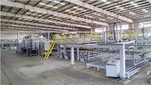
Plastic Engineer Pelletizing Line
Plastic Engineer Pelletizing Line feature
Engineering Plastics pelletizing serises are the main application of twin screw compounding filed , which can be used for polymer coloring, filling and blending, and also other mechanics, electrical, thermoplastics, optical, processability, and anti-environment and anti-biological function modification.
Main technical parameters
|
Model |
L/D ratio |
Speed |
Capacity for reference |
|
CJWH-65 |
36-48 |
400-900rpm |
300-800kg/hr |
|
CJWH-75 |
36-48 |
400-900rpm |
500-1000kg/hr |
|
CJWH-95 |
36-48 |
400-900rpm |
800-1500kg/hr |
Client Case
Model:CJWS 65-40D
Formulation: PC+Short glass fiber
Capacity: 300~500kg/h
Customer: Taiwan,China
Plastic Engineer Pelletizing Line
This application is the main field of twin-screw compounding applications. It can be used for polymer coloring modification, filling blending modification, and other various mechanical, electrical, thermal, optical, environmental resistance and biological resistance modifications.
Engineering plastic modification process flow
The modification process of engineering plastics usually includes the following key steps:
Raw material preparation
At this stage, various raw and auxiliary materials need to be configured according to the product formula ratio, which is usually done through electronic scales or automatic feeding scales. Ensure that the proportions of various raw materials and auxiliary materials meet the product formula requirements.
Mixing
The materials mixed in a certain proportion are put into the mixer and mixed evenly at a certain temperature according to the different processing characteristics of the materials. This step is usually accomplished using a high and low speed mixer.
Extrusion
The mixed materials are melt-mixed through a twin-screw extruder so that the various components are evenly dispersed throughout the system. During this process, the material is heated and plasticized before being extruded from the extruder.
Cooling down
The extruded material strips will be cooled by water or air cooling to fully cool them. This step helps prevent the material from deforming or degrading at high temperatures.
Pellet Cutting
The cooled material strips will be cut into pellets by a pelletizer to obtain plastic particles. Pelletizer selection and operating parameters (e.g. speed, temperature) affect particle size and shape.
Screening and testing
The pelletized plastic particles may be too long or too fine and need to be filtered through a vibrating screen to ensure that the particles entering the finished product bin meet the specifications. In addition, quality inspections are required to ensure that product performance meets standards.
Finished product storage and packaging
Plastic pellets that pass inspection are sent to the finished product bin, where they may be mixed again to ensure uniformity of the pellets. Finally, the entire modified plastic production process is completed by weighing and loading the coding board.
These steps constitute the basic process flow for engineering plastic modification, and different companies may make adjustments based on specific product needs and production conditions.
Why choose JWELL Plastic Engineer Compounding Machine?
1.JWELL has rich experience in Plastic Engineer compounding machines, with many client cases.
2.JWELL Plastic Engineer compounding machines are good quality with good price.
3.High energy saving, high efficiency production and good quality of final product. Reliable.
4.Able to process a wide range of materials. They are capable of handling a variety of polymers, additives, and fillers, which gives plastic engineers more flexibility in their work.
5.Easy to use. The user-friendly interfaces that make operation simple and intuitive. This means that plastic engineers can spend less time learning how to use the equipment, and more time focusing on their work.
6.JWELL compounding machine is built to last. They are made from high-quality materials and are designed to withstand heavy use over time. This means that plastic engineers can rely on the equipment to perform consistently, even under demanding conditions.
Overall, plastic engineers who use JWELL compounding machines can benefit from their versatility, ease of use, high output rates, and durability. These machines are a reliable tool for any plastic engineer who needs to create custom blends quickly and efficiently.
Main technical parameters
|
Model |
Diameter mm |
Max. Screw speed rpm |
Capacity for reference kg/hr |
|
HT50 |
1.55 |
1200 |
400-800 |
|
HT65 |
1.55 |
900 |
600-1200 |
|
HT75 |
1.55 |
900 |
1000-1800 |
|
HT95 |
1.55 |
700 |
2000-3000 |
Hot Tags: Plastic Engineer Pelletizing Line, China Plastic Engineer Pelletizing Line manufacturers, suppliers, factory




- Tel: +8613816974389
- Email: salsz@jwell.cn
- Add: Shanghai Haining Suzhou Changzhou Zhoushan Chuzhou Thailand Spain