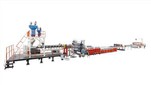
PVC plastics are used for PVC pipes, PVC profiles, PVC hard materials and plates, PVC coated products and PVC transparent sheets, etc. Other methods to improve the heat resistance of PVC plastics are VC copolymers, adding glass fibers to PVC and PVC chlorination. The following will introduce the details.

Uses of PVC plastics

Polyvinyl chloride profiles
Profiles and profiles are the largest consumer of PVC in my country, accounting for about 25% of the total PVC consumption. They are mainly used to make doors and windows and energy-saving materials. Their application volume is still growing significantly across the country. In developed countries, the market share of plastic doors and windows is also the highest, such as 50% in Germany, 56% in France, and 45% in the United States.
PVC pipe
Among the numerous PVC products, PVC pipes are the second largest consumer, accounting for about 20% of its consumption. In my country, PVC pipes were developed earlier than PE pipes and PP pipes, with a wide variety, excellent performance, and a wide range of uses, occupying an important position in the market.


Polyvinyl chloride film
PVC film ranks third in PVC consumption, accounting for about 10%. After PVC is mixed with additives and plasticized, it is made into a transparent or colored film of specified thickness using a three-roller or four-roller calender. The film processed in this way becomes a calendered film. It can also be cut and heat-sealed to make packaging bags, raincoats, tablecloths, curtains, inflatable toys, etc. Wide transparent films can be used for greenhouses, plastic greenhouses and ground films. The film that has been biaxially stretched has the property of shrinking due to heat, and can be used for shrink packaging.
PVC hard materials and sheets
Stabilizers, lubricants and fillers are added to PVC. After mixing, the extruder can be used to extrude various calibers of hard pipes, special-shaped pipes, and corrugated pipes, which are used as sewer pipes, drinking water pipes, wire casings or stair handrails. The rolled sheets are overlapped and hot-pressed to make hard sheets of various thicknesses. The sheets can be cut into the required shape, and then PVC welding rods are used to weld with hot air into various chemical-resistant storage tanks, air ducts and containers.

PVC general soft products
Using an extruder, it can be extruded into hoses, cables, wires, etc.; using an injection molding machine with various molds, it can be made into plastic sandals, soles, slippers, toys, auto parts, etc.
Polyvinyl chloride packaging materials
Polyvinyl chloride products are mainly used for packaging various containers, films and hard sheets. PVC containers are mainly used to produce mineral water, beverages, and cosmetic bottles, and are also used for packaging refined oils. PVC film can be used to co-extrude with other polymers to produce low-cost laminated products and transparent products with good barrier properties. Polyvinyl chloride film can also be used for stretch or heat shrink packaging, and is used to package mattresses, cloth, toys and industrial goods.
Polyvinyl chloride wainscots and floors
Polyvinyl chloride wainscots are mainly used to replace aluminum wainscots. In addition to a portion of polyvinyl chloride resin, the remaining components of polyvinyl chloride floor tiles are recycled materials, adhesives, fillers and other components. They are mainly used on the hard floors of airport terminals and other places.
PVC daily consumer goods
Luggage bags are traditional products made from PVC. PVC is used to make various imitation leathers for luggage bags, sports products such as basketballs, footballs and rugby. It can also be used to make belts for uniforms and special protective equipment. PVC fabrics for clothing are generally absorbent fabrics (no coating required), such as raincoats, baby pants, imitation leather jackets and various rain boots. PVC is used in many sports and entertainment products, such as toys, records and sports equipment. PVC toys and sports equipment have a large growth rate, because of their low production cost and easy molding, they have an advantage.

PVC coated products
Artificial leather with a backing is made by applying PVC paste on cloth or paper and then plasticizing it at above 100°C. It can also be made by first rolling PVC and additives into a film and then pressing it with a backing. Artificial leather without a backing is directly rolled into a soft sheet of a certain thickness by a calender and then pressed with a pattern. Artificial leather can be used to make suitcases, bags, book covers, sofa and car seat cushions, etc., as well as floor leather, which is used as a floor covering material for buildings.
PVC foam products
When mixing soft PVC, add an appropriate amount of foaming agent to make sheets, which are foamed and molded into foam plastics. They can be used as foam slippers, sandals, insoles, and shock-proof cushioning packaging materials. They can also be made into low-foaming hard PVC sheets and profiles by extruders, which can replace wood and are a new type of building material.


PVC transparent sheet
PVC is added with impact modifier and organic tin stabilizer, and becomes transparent sheet through mixing, plasticization and calendering. It can be made into thin-walled transparent containers or used for vacuum blister packaging by thermoforming, and is an excellent packaging material and decorative material.
Others
Doors and windows are assembled from hard special-shaped materials. In some countries, they have occupied the door and window market together with wooden doors and windows and aluminum windows; imitation wood materials, steel substitute building materials (northern, seaside); hollow containers.

Methods for improving heat resistance of PVC plastics
VC copolymer
If the composition of VC (vinyl chloride) and other monomer copolymer resins contains polar or large group components, the heat deformation temperature of the copolymer will increase accordingly, and the heat resistance will be better than PVC, and heat-resistant products can be produced. The softening temperature of PVC is 78℃, while the softening temperatures of copolymers vinyl chloride-vinylidene chloride, vinyl chloride-methyl methacrylate, and vinyl chloride-acrylonitrile are 100~130, 85, and 140~150℃ respectively.
PVC chlorination
It is made by chlorination of PVC resin, and its chlorine content is 62%~68%. Chlorinated polyvinyl chloride can be used continuously at 100℃ (20~35℃ higher than PVC), and the maximum operating temperature can reach 100-105℃, and its chemical stability, flame retardancy, and cold resistance are better than PVC. However, the anti-corrosion requirements of chlorination equipment are strict, the resin is not easy to process, and the poor impact toughness restricts its application and development.
PVC cross-linking
Cross-linked PVC can be made by radiation cross-linking and chemical cross-linking. Compared with ordinary PVC products, cross-linked PVC products have higher mechanical strength, better dimensional stability, better heat deformation resistance, wear resistance, and chemical resistance. Radiation cross-linked wires can be used continuously at 100-110°C.
Blending of PVC with other polymers
PVC is mixed with other polymers in a certain proportion, and the performance of the blend (full compatibility) is improved compared with PVC. Because the two compatible polymers can be mixed at the molecular level to form a single-phase structure, the performance of the blend is supplemented and strengthened, such as PVC/PS, PVC/PE, PVC/CPVC, etc.
Adding heat-resistant modifiers
Heat-resistant modifiers are a type of polymer with high heat resistance developed and produced to improve the heat resistance of PVC.
Adding inorganic materials to PVC
After adding a certain amount of filler, the heat resistance of PVC can be improved. Commonly used fillers are: heavy calcium carbonate, light calcium carbonate, precipitated calcium carbonate, calcined pottery, barium sulfate, red mud, titanium powder, etc.

Adding glass fiber to PVC
Adding 20%~30% glass fiber to PVC can increase its heat resistance to above 100℃. It makes the PVC resin and glass fiber bond well without adding (or adding less) plasticizer. Especially for long fiber reinforced PVC, the increase in heat deformation temperature is more obvious.
Ordinary CPVC improves Vicat
The processing performance of the material will deteriorate, and an impact modifier needs to be added to offset it. Using α-methylstyrene to increase Vicat (every 1% added increases Vicat by about 2-3℃), the processing temperature will increase and the physical and mechanical properties will also decrease, but the magnitude is smaller than that of CPVC, and an impact modifier must also be added to offset it.