


The pharmaceutical industry has borrowed processing technology from plastic blending to form a unique pharmaceutical blending method. In turn, we can learn a lot from the borrowers. Interestingly, learners will definitely develop previous technologies from different perspectives, which in turn will form new inspirations for learners. For example:
1. Pharmaceutical TSE pays more attention to regulations and guidance documents, especially the dynamic pharmaceutical manufacturing practice (cGMP) used in pharmaceutical operations, which can make manufacturing more stable, reproducible, and more efficient. In today's pursuit of intelligent manufacturing, these normative measures are very meaningful, because standardized operations are the basis and premise of intelligence.
2. The preference for certain types of TSE, such as the preference for counter-rotating intermeshing twin-screw extruders, is an interesting phenomenon that deserves analysis.
3. It is worth noting the emphasis on certain plastic TSE technologies. For example, by re-examining the function of starvation feeding, we may be able to learn from PP volatilization and reduce odor, and the experience of avoiding excessive shearing in the back-end feeding of the processing area is inspiring for light-diffusing plastics.
Twin-screw extrusion has been the standard process for plastics compounding for decades, but it has only been accepted by the pharmaceutical industry in recent years. Here's what plastic compounders can learn from our little brother, the drug maker, to help us make better and more consistent products.

The system uses a twin-screw extruder to manufacture drug delivery products. This twin-screw extrusion granulation system features an air-cooled conveyor belt and in-line thickness determination to produce microparticles of approximately 0.8 mm for microcapsule filling.
For more than 50 years, twin-screw extrusion has been a well-established technology for manufacturing plastic blends. Before twin-screw extruders (TSE) were accepted, mixers and single-screw extruders were often the compounding equipment of choice for compounders. But today, TSE is the preferred choice for plastic compounding due to the stable production of many different formulations on the same extruder and its self-cleaning properties.
Over the past few decades, the pharmaceutical industry has also embraced twin-screw extruders for the production of a myriad of pharmaceuticals and multifunctional medical devices. TSE is now commonly used to compound active pharmaceutical ingredients together with polymers and excipients, where the polymers and excipients serve as linkers. As in masterbatch applications, TSE is used as a continuous mixer to manufacture high quality, consistent dosage forms for drug delivery, including tablets, implantable devices, wound care and many other products. Applications range from controlled release systems to oral bioavailability improvement.
There is no doubt that pharmaceutical companies have reaped the benefits of 100 years of TSE technology development and process optimization, including industrial achievements and research results in plastics. But now is the time for plastics companies to follow in the footsteps of pharmaceutical companies and—at least some of the time—implement the dynamic good manufacturing practices (cGMP) used in pharmaceutical operations to ensure manufacturing efficiencies and create better products .
Leading development activities in the late 1980s and 1990s resulted in several commercial drug delivery components that rely on TSEs. Driven by the FDA's Process Analytical Technology activities, the use of twin-screw extruders has since become accepted by truly the majority of world-class pharmaceutical companies.
Historically, most drug delivery formulations have been manufactured through compounding processes. The FDA's 2004 PAT activity provides drug manufacturers with a framework to guide drug development, manufacturing, and quality assurance through online monitoring. In short, PAT activities strongly encourage that new agents should be developed and manufactured through continuous processing with on-line monitoring of key parameters. This file could simply have been written by an extruder supplier.
Twin-screw extruders process material in a channel that is connected adjacently by the screw and the barrel wall, so it is called a small-batch continuous mixer. The motor inputs energy into the process, and the mixing is carried out by rotating the screw. Process control parameters include screw speed (rpm), feed rate, temperature along the barrel to the die, and exhaust vacuum. Typical parameters that are monitored for in-line quality measurement include melt pressure, melt temperature, motor current and in-line IR sensors. Programmable logic controllers (PLCs) and touchscreen human-machine interfaces (HMIs) are now commonplace equipment compared to the older isolated controls and instrument readouts.
The basic design of a TSE for plastics or pharmaceuticals is the same. The mixing principle and unit operation segmentation are essentially the same. TSE processing technologies proven in industrial processing facilities can often be quickly implemented in pharmaceutical processes—TSE processing is a definite given.
TSE utilizes segmented threads assembled on high torque screw shafts. The barrel is also modular and integrated with internal bores for barrel cooling. The segmented screw and barrel, combined with the controlled pumping and self-cleaning properties of the co-rotating screws, allow the screw/barrel geometry to be matched to the processing task. The counter-rotating intermeshing twin-screw pattern is also used for processing PVC, masterbatches and pharmaceutical compounding applications.
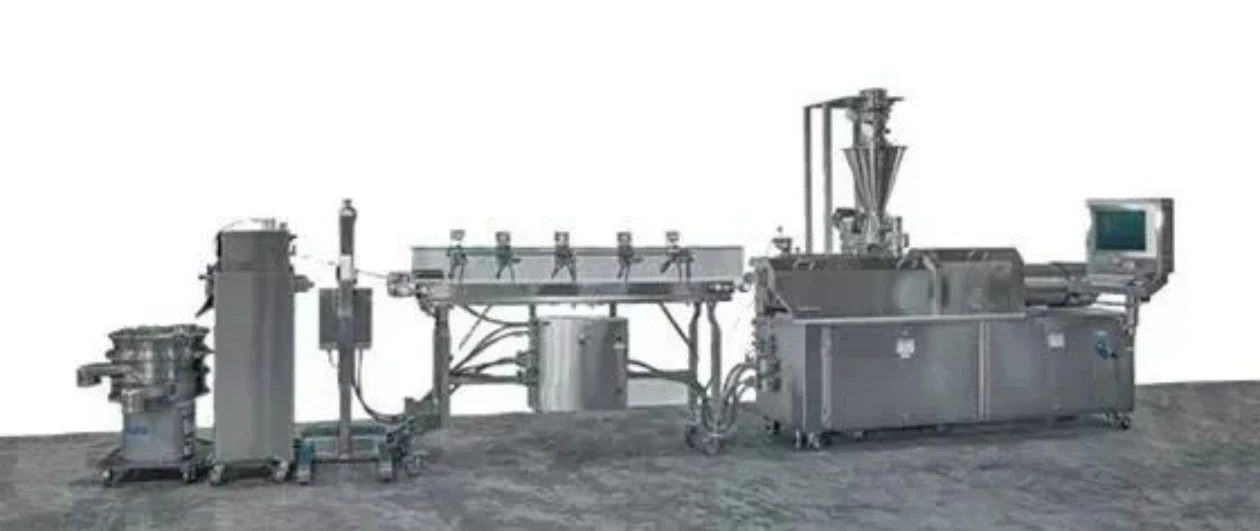
Compared with large-volume reciprocating mixers, TSE's inherent high-intensity mixing and short-time mass exchange characteristics between the screws are conducive to efficient mixing operations. Trapped air, moisture and volatiles are removed by vacuum exhaust during the extrusion process. The relatively short residence time (1 second to 2 minutes) in the TSE is advantageous for many heat and shear sensitive materials, because the TSE can be designed to limit its exposure to high temperatures to only a few seconds.
TSE uses starvation feeding, and the production rate is determined by the feeder, which metered pellets, liquids, powders and fibers to the processing section. TSE screw speed does not depend on feed rate, due to optimal blending efficiency. Like pigments, some APIs (active pharmaceutical ingredients) require dispersive mixing in TSE, while others benefit from distributive mixing. For example, a shear-sensitive API or pigment can be metered in at the back end of the processing section to avoid high shear strength under melt conditions.
Co-rotating TSE currently represents 90% of the TSE used to produce masterbatch products. Interestingly, a high proportion of counter-rotating intermeshing TSEs are used by pharmaceutical manufacturers, perhaps because they do not have a preset preference for co-rotating twin-screws.
An example of a critical process parameter that is monitored (depending on whether it is a plastic blend, masterbatch or formulation) is specific energy (SE), which is defined as the energy input per unit mass of material being processed. If there is a sudden change in SE, it means, equipment, process conditions or raw materials have changed, and the end product may become different.
SE is calculated as follows:
KW (real-time) = kW (motor power) X% torque XRPM (running) / maximum RPMX0.97 (gearbox efficiency)
so:
Specific energy = kW (real time) / ((kg/hr))
unit:
SE is marked as kW per kg/hr
KW=kilowatt (motor power in kW=HPX0.746)
%Torque = Percentage of maximum allowable torque usage
RPM=Screw rotation speed/minute
It's also possible to make a solid box that monitors and records the SE of any extrusion process, however, often enough it's unmonitored and it's worth asking why it's not being monitored.
For pharmaceutical applications, downstream systems are also similar to plastics. Strand and die face pellets are used for water soluble pharmaceutical products. In addition to water, the particles are also annealed on the conveyor belt, or transported and cooled in air to facilitate granulation. Smaller particles can be used for direct microencapsulation filling, while larger particles are generally ground and compressed into tablets. Laminated systems are used for subcutaneous and insoluble film applications. Tubing systems produce antimicrobial structures, while coextruded rods are integrated into contraceptive devices (e.g. vaginal rings). Such applications are infinite.
TSEs used in a cGMP environment generally comply with FDA Part 11 of Title 21 of the Code of Federal Regulations (CFR) on Electronic Records and Electronic Signatures, which sets out the standards by which electronic records should be honest and reliable. In practice, Part 11 requires drug manufacturers to implement controls, audits, and system validation of software and systems involved in processing electronic data. The parameters being monitored must be verified and periodically calibrated - a good practice for extrusion installations.
Protocols must be followed to limit access to the system by authorized individuals and to perform operational verification, equipment verification, control of system documentation and a host of other instructional documents. Strict adherence to methods for copying and retention of records is part of the guidance document.
Device qualification documentation associated with installation in a pharmaceutical-grade environment must be more elaborate than that of a typical plastic device. Pharmaceutical grade installations take months of time and work to complete the installation and commissioning of equipment, requiring a detailed project-specific documentation package (FAT), installation qualification (IQ) and operational qualification (OQ).
There are also cGMP guidelines for cleaning pharmaceutical grade TSE systems. For example, equipment must be cleaned at appropriate intervals according to documented procedures that are specific and detailed. After cleaning, the equipment is protected from contamination until it is used, and its cleanliness is checked just before use. Records and equipment logs of all clean-ups and inspections must be kept and the time between completion of processing and clean-out must be recorded. A similar protocol would benefit any plastics processing operation.
Due to the regulatory requirements inherent in the manufacture of pharmaceuticals, all aspects related to the TSE manufacturing unit require a more strictly controlled and documented approach than the standard activities of the plastics industry.
Our suggestion here is not that FDA guidance and regulations for pharmaceutical products can be strictly applied to the manufacture of plastic blends, but that it may be useful to audit the activities of pharmaceutical manufacturing companies and selectively implement those that are practical and useful. stuff, which helps to make a more stable and repeatable product.


